How to Get More Google Reviews (Without Being Annoying)
February 12, 2026
Your SEO company can't get you reviews. They can set up systems, send reminders, maybe even nag you about it. But they're not the ones doing the work. They're not the ones the customer interacts with.
Reviews are on you.
The good news: getting reviews isn't complicated. It just requires being intentional about it.
Why reviews matter more than you think
For local businesses, reviews are the most important factor in whether someone chooses you over a competitor. More important than your website design. More important than your meta tags. More important than whatever your SEO agency is doing for $800/month.
People trust reviews because they're from other customers, not from you. A hundred people saying you're good is more convincing than you saying you're good.
Google knows this too. Review quantity, quality, and recency all factor into local search rankings.
Automatic systems (set up once, runs forever)
The best review systems don't require you to remember to ask. They just happen.
For location-based businesses (restaurants, retail, salons, lawyers, clinics)
QR codes everywhere. Put them on receipts, table tents, counter signs, the bottom of menus. Goes directly to your Google review page-not your website, not a survey, the actual review form.
NFC tap cards. A card at checkout that customers can tap with their phone. Opens the review page instantly. Feels modern, takes two seconds.
Automated follow-up. After an appointment (salon, dentist, clinic), send a text or email that evening or next morning. "Thanks for coming in today. If you have a minute, we'd love a review: [link]"
The key: make it one tap from the message to the review form. No extra steps.
For home services (plumbers, electricians, contractors, cleaners)
Text right after the job. This is the golden moment. The water's running again. The AC works. They're relieved and happy. Send a text within an hour of job completion: "Thanks for choosing us. If you're happy with the work, a review really helps: [link]"
QR code on the invoice. Whether you hand them a paper invoice or email one, include a QR code and a short ask.
Leave-behind card. A small card left at the job site. "Thanks for trusting us with your home. If you have a minute, we'd appreciate a review." QR code. Done.
Next-day follow-up. Call, text or email the next day to make sure everything's still working. If it is, that's another natural moment to ask. If it's not, you just saved yourself a bad review by catching the problem early.
Manual asks (the human version)
Automation helps, but the most effective ask is still person-to-person at the right moment.
The "happy moment" ask
For home services, this is right when the job is done. The problem is fixed. They're relieved. That's when you say:
"If you're happy with the work, a Google review really helps us out. I can text you a link right now."
For location-based businesses, it's when they compliment the food, the haircut, the service:
"Thank you! If you have a minute later, we'd love a review on Google."
Train your team to recognize it
This shouldn't be scripted or forced. Not every customer, not every time. But when someone expresses genuine satisfaction, that's the moment. Train your staff to recognize it and make the ask naturally.
The follow-up call
Old school, but effective. Call the next day to make sure everything's good.
If it is: "Great, glad to hear it. If you get a chance, a Google review really helps us out."
If it's not: "Let me get that fixed for you." You just turned a potential 1-star review into a recovery opportunity.
How to get reviews that actually help
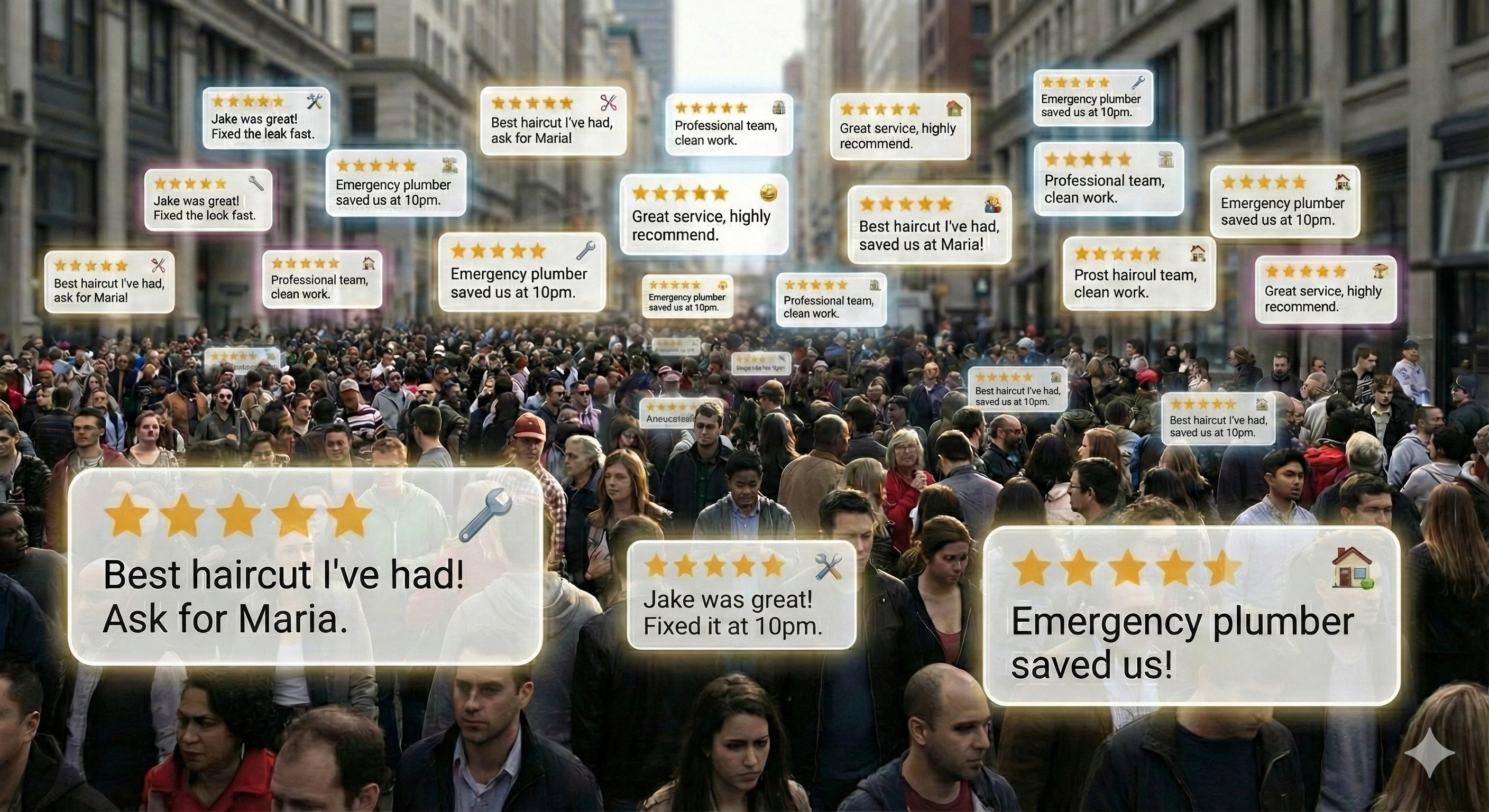
"Great service, 5 stars" is nice. But it doesn't help future customers understand what to expect.
Encourage reviewers to mention:
The specific service. "They fixed our water heater" or "Got a haircut and beard trim"
The person who helped them. "Jake was great" or "Ask for Maria"
Their situation. "We had a leak at 10pm and they came out the same night" or "Got us in last minute before a wedding"
You can prompt this when you ask: "If you leave a review, it really helps if you mention what we did and who helped you-it helps other customers know what to expect."
This also helps with search. A review that mentions "emergency plumber" or "wedding hair" contains keywords that help you show up for those searches.
Responding to reviews (yes, all of them)
Every review gets a response. Good and bad.
Good reviews
- Thank them by name
- Reference something specific ("Glad we could get your AC fixed before the heat wave!")
- Keep it short and genuine, not corporate
Don't copy-paste the same response to every review. People notice.
Bad reviews
Respond quickly. Don't get defensive. Don't argue publicly.
A good template:
"I'm sorry to hear this. That's not the experience we want anyone to have. Please call me directly at [number] so I can make this right."
This does two things: it shows future customers you take problems seriously, and it moves the conversation offline where you can actually fix it.
Here's the thing: a thoughtful response to a 2-star review can be more persuasive than ten 5-star reviews. It shows you're paying attention and you care when things go wrong.
You don't need a 5.0
This surprises people: 4.7 with 150 reviews beats 5.0 with 12 reviews.
Why:
Volume signals legitimacy. A business with 200 reviews has been around, has served a lot of people, has been tested.
Perfect scores look suspicious. Some people assume 5.0 means fake reviews or only friends and family reviewed. A few 4-star reviews mixed in actually builds trust.
Recency matters. 50 reviews from 2019 isn't as valuable as 30 reviews from the last 6 months. Google notices when you stop getting reviews. So do customers.
The goal isn't perfection. The goal is consistent, recent, authentic reviews.
Know what you're competing against
Before you worry about your review count, look at your competitors.
- How many reviews do they have?
- What's their average rating?
- How often do they get new ones? (A competitor with 100 reviews but none in the last 6 months is stagnant.)
- What do people complain about? (That's your opportunity to be better.)
- What do people praise? (Make sure you're doing that too.)
If your top competitor has 80 reviews at 4.6, and you have 15 reviews at 4.8, you're probably losing. The 80 reviews signal "established, trusted, lots of customers." Your slightly higher rating doesn't overcome that gap.
Do the math: how many reviews per month do you need to catch up or stay ahead? Make that your target.
The summary
This is on you, not your SEO company. They can set up systems. You deliver the experience that earns reviews.
Automate what you can. QR codes, follow-up texts, leave-behind cards. Set it up once, let it run.
Ask at the happy moment. Right after the job is done, right when they compliment you. That's when the ask works.
Guide them toward useful reviews. Mention the service, the person, the situation.
Respond to every review. Good ones get thanks. Bad ones get addressed quickly and moved offline.
5.0 isn't the goal. Volume and recency beat a perfect score.
Know your competition. You're not trying to hit some abstract number. You're trying to beat the other options customers are considering.
Reviews aren't a mystery. They're just a habit you build into how you run your business.
Questions About Your Website, SEO, or AI Search?
Whether you're ready to get started or just want to learn more about how we can help your business get found online, we're here to answer your questions.
Whether you're ready to get started or just want to learn more about how we can help your business get found online, we're here to answer your questions.